[Topics]
Eugenics
Is a no-brainer, really. Do you want to be ugly? Dumb? Sick? Mentally ill?
Or your children to be like that?
Surely, one of the dumbest “arguments” against it is calling it a
“pseudo-science”.
Even an imbecile like Richie Dawkins understands (The Greatest Show
on Earth):
Political opposition to eugenic breeding of humans sometimes spills over
into the almost certainly false assertion that it is impossible. Not only
is it immoral, you may hear it said, it wouldn’t work. Unfortunately, to
say that something is morally wrong, or politically undesirable, is not to
say that it wouldn’t work. I have no doubt that, if you set your mind to it
and had enough time and enough political power, you could breed a race of
superior body-builders, or high-jumpers, or shot-putters; pearl fishers,
sumo wrestlers, or sprinters; or (I suspect, although now with less confidence
because there are no animal precedents) superior musicians, poets,
mathematicians or wine-tasters. The reason I am confident about selective
breeding for athletic prowess is that the qualities needed are so similar to
those that demonstrably work in the breeding of racehorses and carthorses, of
greyhounds and sledge dogs. The reason I am still pretty confident about the
practical feasibility (though not the moral or political desirability) of
selective breeding for mental or otherwise uniquely human traits is that there
are so few examples where an attempt at selective breeding in animals has
ever failed, even for traits that might have been thought surprising. Who
would have thought, for example, that dogs could be bred for sheep-herding
skills, or “pointing”, or bull-baiting?
Now let us hear Matt Ridley (from Genome, p. 297):
This brief history of eugenics leads me to one firm conclusion.
What is wrong with eugenics is not the science, but the coercion.
Eugenics is like any other programme that puts the social benefit
before the individual’s rights. It is a humanitarian, not a scientific
crime. There is little doubt that eugenic breeding would “work” for
human beings just as it works for dogs and dairy cattle. It would be
possible to reduce the incidence of many mental disorders and improve
the health of the population by selective breeding. But there is also
little doubt that it could only be done very slowly at a gigantic cost
in cruelty, injustice and oppression. Karl Pearson once said, in an
answer to Wedgewood: “What is social is right and there is no definition
of right beyond that.” That dreadful statement should be the epitaph of
eugenics.
(Ridley is wrong about the “cruelty”, of course. It is cruel to bring
sick, mentally ill people into this world.)
Was Adam hunchbacked?
Genetics is destiny.
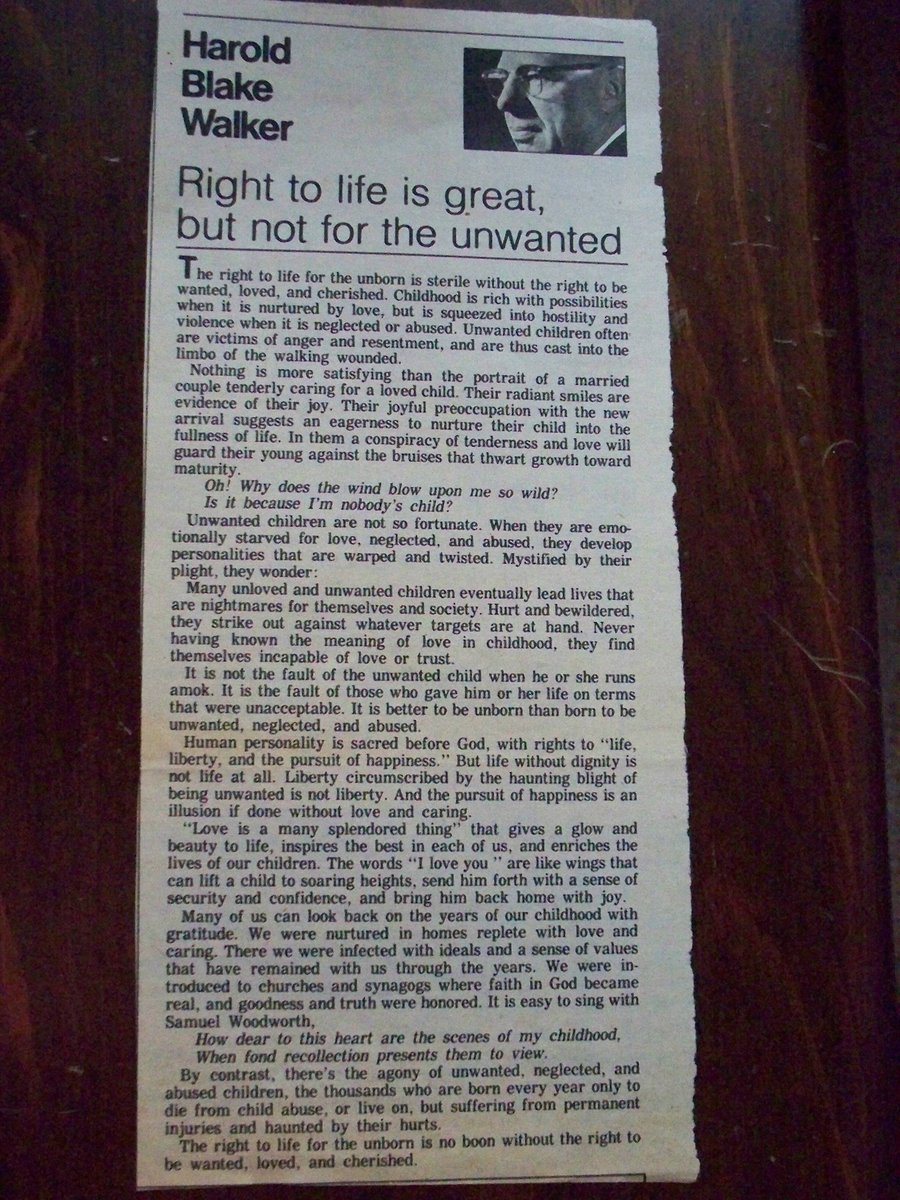
Addition: See also this interesting article by Harold Blake Walker,
Pastor Emeritus of the First Presbyterian Church of Evanston (IL),
former columnist for the Chicago Tribune, former president of the
Board of Trustees of the McCormick Theological Seminary (article
written most likely between the late seventies to mid-eighties):
Right to life is great,
but not for the unwanted.
I have no idea how to implement this in a sensible and “humane”
manner; though I defend eugenics since it is often argued that
it is pseudo-scientific, or inhumane (see the Ridley quote above).
The latter accusation being even more imbecilic than the former.
Nikola Tesla and Francis Crick were in favor of eugenics, too.
Not that I find them in any way inspiring or anything, quite the
opposite. But, again, they realized how important it is that people
like me be spared this nonsensical and awful existence you all
praise so much because you simply are in deep, deep love with yourself.
One reason people often get defensive when someone claims that
genetics is destiny, that genes shape you more than your
environment is that it makes them feel bad about themselves.
Some even acknowledge this, saying that it gives them the feeling
or hope that they can still improve. I believed this myself for
some time, but finally I had to give in to reality and realize
that one’s genes play a more important role after I looked into
the research. This is also why I don’t take anyone seriously
who tries to make the point that nurture is more important.
It can’t be. And you cannot even choose your environment or the
time you’ll be living in either. I know my own limitations well
enough, and if someone told me I could become a Goethe or Shakespeare
or Kierkegaard, I would laugh him off.
It gives people the cosy feeling of blaming others for their failures,
instead of accepting that they really had not much influence on any
of their shortcomings. At best, one may blame their parents. After all,
a lot gets inherited, and if I had children—as written above—, they
would be the same ugly losers that I am. Or maybe blame the state, who
did not sterilize those parents. And so on. But instead, they blame those
who are the least responsible.
How does this fit in with my Christian worldview? Not much of a problem,
really: we are responsible morally, but if I hardly graduate high
school, if I am an ugly hunchback, I am not at fault for not having become
a lawyer or popular with the girls. It was never in my reach, and so those
who talk about “God-given talents” really
are only in love with themselves, because I have no talents, I have
nothing to be proud of. I’m a horrible loser.
Some do support eugenics, but then they do it only in a wicked way,
by denigrating, for example, a commenter who defended eugenics, writing
that of course mentally ill trash should not reproduce, exempting
themselves from that category. It is all well and good if not all
supporters of eugenics want themselves to be sterilized. However,
seeing oneself as superior (genetically) to others and calling them
trash is just vulgar.
To those who say that this world and life itself is tainted by sin,
that there is no perfect life, we all suffer more or less and so on:
this is true in general, but it is false in the particular. I have taken
this view myself on these pages.
My point, though, is that mental illness is something not everyone
suffers from, neither do many suffer from being hunchbacks. There are
people who never really suffer much in their lives, neither physically
or mentally. No one knows who will be saved or not (I speak from a
Christian standpoint): some might suffer a lot and be damned to eternal
torture. Only God knows.
Schopenhauer quotes Lord Byron in the II. volume of his The World
as Will and Representation (Chapter XLVI. On The Vanity And
Suffering Of Life), in his addition to the fourth book of the I.
volume:
Our life is a false nature—’tis not in

The harmony of things, this hard decree,

This uneradicable taint of sin,

This boundless Upas, this all-blasting tree

Whose root is earth, whose leaves and branches be

The skies, which rain their plagues on men like dew—

Disease, death, bondage—all the woes we see—

And worse, the woes we see not—which throb through

The immedicable soul, with heart-aches ever new.
Even the German Christian physician Dr. Karl Weißbrodt, in a small book
titled The Conjugal Duty (Die eheliche Pflicht), writes
that certain people must not marry, or only after they fully recovered
from their afflictions. And some of those he mentions are permanent.
He continues that this should be taken into consideration not only for
oneself and one’s spouse, but also for the children and lineage one is
about to have as a married man or woman. And who did he ask to refrain
from marrying?
Bingo! Hunchbacks, among others. And his book was lauded by
several clerics.
I will end this with a quote by Kierkegaard, who was hunchbacked and
mentally ill too. He, however, was gifted with such a brilliant mind
as are only very, very few individuals. If such exist at all in all
centuries.
I, on the other hand, have to endure my mediocre existence: no great
theological works will come forth from my lousy pen.
ANOTHER MENDACIOUS USE OF CHRISTIANITY
No doubt very many, and very different, things preoccupy people. But if
one were to name just one thing of which one would say that it was the
only thing people are preoccupied with, it would have to be relations
between the sexes, sexual desire, propagation, etc. – for human beings
are, after all, mainly animal.
That is why everything, absolutely everything that human hypocrisy can
invent comes together on this point, as on no other. If you really want
to learn to recognize human hypocrisy, this is where to look. For it is
precisely because here we are standing at the lowest level – something
they would be too ashamed simply to admit – that here hypocrisy comes
into its own. Hence the elevated talk of the profound seriousness of
propagating the race, of the great benefaction of bestowing life upon
another human being, etc., all of it calculated in addition to refine the
voluptuousness of desire.
The great benefaction of bestowing life on another human being. Bless my
soul! A tired lecher, an old man who hardly has the sensual power – the
truth is they were unable to control the flame of lust. But one puts it
hypocritically by saying that they intended to perform the great
benefaction of bestowing life upon another human being! Thanks! And
what a life, this miserable, wretched, anguished existence which is
usually the lot of such an offspring. Isn’t it splendid? Suppose murder
and pillage and theft were similarly made into the greatest, most
priceless benefaction! And what is putting a man to death compared with
bringing such a wretched creature into life? For even if it is commonly
considered a melancholic thought (as, if I recall, one of my pseudonymns
says somewhere, or is to be found somewhere in my journal, or in any
case a remark I made long, long ago) that there should be greater guilt
in giving life than in taking it – even if in general it may indeed be
too melancholic, yet in the case of the offspring whose life is destined
to be sickly it is not an exaggeration. Yet this hypocrisy about a great
benefaction is upheld; the child is supposed never to be able to give
thanks enough – instead of the father never being able to expiate his
guilt even if he went on his knees, in tears, before the child.
But to the hypocritical use of Christianity. This is making it look as
though Christian parents – and of course in Christian countries everyone
is a Christian – beget Christian children – but then coming into existence
is identical with receiving an eternal salvation. Aha! So the meaning of
Christianity has become the refinement of the lust of the procreative
act. One might perhaps otherwise just stop, see if one can control the
urge, hesitate to give another person life merely to satisfy sexual
desire – ah, but when one begets eternal, eternally blessed creatures,
isn’t the best and most Christian thing not to do anything else all day
long if that were possible?
(1854; XI I A 219)
From Papers and Journals, translated by Alistair Hannay.
From
christiananswers.net:
[…] If such a tactic does not work, then forced sterilization may be a
viable—albeit desperate—option, since it does not entail the death of
the unborn. […]
To quote from
thefriendshipbench.org/a-letter-to-parents-surviving-a-childs-suicide/:
My son of 42 years committed suicide on Dec.22, 2020, they found
his body on Christmas Day. He left behind his brother 46, and his son
and daughter 21 and me. I am not mad at him, I am mad at all the people
who kept it from me. I live 4000 miles away and I had to learn of my
son’s death from facebook of all places. Three weeks after the fact.
He was cremated and buried before I even knew he was gone. I feel mostly
guilt. I have chronic depression and have tried to kill myself many
times. I fear it is a hereditary disease. My older son also has chronic
depression and wishes to die all the time like I do. We both sought
help, my younger son did not. He didn’t show any signs of depression,
except he was angry all the time, and had trouble controlling his temper,
as attested to by his long list of failed relationships. I don’t know
how to get rid of the guilt. I have no one to talk to, my girlfriends
just said they were sorry for me. My husband, not his father, said that’s
to bad and went on about his day. I got no emotional support. How my life
after death will work itself out, remains to be seen.
(Emphasis mine.)
I am not trying to exploit such a tragedy, but it is pretty clear
that there is a strong genetic component to mental illness, given that
it seems to run in certain families. See the Jordan Peterson
quote too, for example.
Quoting Sir Keith Joseph from a speech he held in 1974 at Edgbaston
(“our human stock is threatened”) (mirror):
[…]
The balance of our population, our human stock is threatened. A
recent article in Poverty, published by the Child Poverty Action Group,
showed that a high and rising proportion of children are being born to
mothers least fitted to bring children into the world and bring them up.
They are born to mothers who were first pregnant in adolescence in social
classes 4 and 5. Many of these girls are unmarried, many are deserted
or divorced or soon will be. Some are of low intelligence, most of low
educational attainment. They are unlikely to be able to give children the
stable emotional background, the consistent combination of love and
firmness which are more important than riches. They are producing
problem children, the future unmarried mothers, delinquents, denizens of
our borstals, sub-normal educational establishments, prisons, hostels for
drifters. Yet these mothers, the under-twenties in many cases, single
parents, from classes 4 and 5, are now producing a third of all births.
A high proportion of these births are a tragedy for the mother, the child
and for us.
Yet what shall we do? If we do nothing, the nation moves towards
degeneration, however much resources we pour into preventative work and
the over-burdened educational system. It is all the more serious when
we think of the loss of people with talent and initiative through emigration
as our semi-socialism deprives them of adequate opportunities, rewards and
satisfactions.
Yet proposals to extend birth-control facilities to these classes of people,
particularly the young unmarried girls, the potential young unmarried mothers,
evokes entirely understandable moral opposition. Is it not condoning
immorality? I suppose it is. But which is the lesser evil, until we are able
to remoralise whole groups and classes of people, undoing the harm done
when already weak restraints on strong instincts are further weakened by
permissiveness in television, in films, on bookstalls?
The worship of instinct, of spontaneity, the rejection of self-discipline,
is not progress — it is degeneration.
It was Freud who argued that repression of instincts is the price we pay for
civilisation. He considered the price well-paid. So can we, now. But we
must see the dilemmas, we must argue it out among ourselves, to find a way through
these moral dilemmas, while we fight for our ideals in wider fora through
words and deeds. But you may ask what can fallible politicians in short-lived
governments do in the face of all these tidal forces? Most of what needs to be
done, I have stressed, is for individuals as themselves and as members of all
manner of bodies. But some tasks are for government, and to these I will
return on a future occasion.
This could be a watershed in our national existence. Are we to move
towards moral decline reflected and intensified by economic decline,
by the corrosive effects of inflation? Or can we remoralise our national
life, of which the economy is an integral part? It is up to us,
to people like you and me.
(Emphasis mine.)
Unfortunately, no one listened — at least no one who could’ve changed course.
Laura Loomer is said to be mentally ill, just like her mother and two brothers,
one of which is a violent schizophrenic, the other one suffering from depression.
So it runs in families and eugenics would have spared us that nonsense.
Especially since life is not a gift and really not that great, so we would not
have missed out on anything. Only by having been born does one then
have skin in the game, for stupid reasons, though.
Says Gómez Dávila:
Eugenics appals those who fear its judgment.
No beneficiary of slaves is supporter of birth control.
The individual who lies to himself, just like the society that
does not lie to itself, soon rots and dies.
Depopulate and reforest – first civilizing rule.
Although it grieves the angelism of the democrat: one cannot build a
civilisation with miserable biological material.
The two most pressing problems of the contemporary world: demographic
expansion and genetic deterioration are unsolvable.
Liberal principles prevent the solution of the first, egalitarian ones that
of the second.
Donald Trump agrees,
too:
[…] you have to be born lucky in the sense that you have to have the
right genes […]